Basic knowledge of mathematics (mainly probability theory) and Python programming (although a crash course would be given)
Course Contents
- Introduction to Machine Learning
- A crash course on python
- Supervised Learning
- Unsupervised Learning
- Neural Networks and Deep Learning
- Reinforcement Learning
- Other Machine Learning Methods
- Applications in Physical Sciences
What you'll learn
This course provides students with a comprehensive understanding of, and hands-on experience with, machine learning algorithms ranging from basic to advanced levels, especially focussing on applications in physical sciences. The course is justified by the transformative shift currently occurring across the scientific landscape, where the traditional paradigms of theory and experiment are being augmented by data-driven discovery. As modern experiments in physics, chemistry, and materials science generate increasingly massive and complex datasets, conventional analytical methods often reach their limits. This course bridges the gap between fundamental physical principles and advanced computational intelligence, equipping researchers with the tools to automate pattern recognition, accelerate simulations, and uncover hidden correlations in high-dimensional data. By integrating machine learning into the physical sciences, students can tackle previously intractable problems such as predicting molecular properties, optimizing quantum circuits, or discovering novel functional materials, thereby driving innovation at the intersection of AI and fundamental science. By the end of this course, the students will be able to:
- 1. Master Core ML Architectures: Develop a deep understanding of supervised and unsupervised learning, ranging from classical regression and clustering to advanced neural network architectures like CNNs, RNNs, and Transformers.
- 2. Apply Physics-Informed AI: Learn how to incorporate physical constraints (such as conservation laws or symmetries) into machine learning models to ensure they remain physically consistent and interpretable.
- Supervised Learning
- Unsupervised Learning
- Neural Networks and Deep Learning
- Reinforcement Learning
- Other Machine Learning Methods
- Applications in Physical Sciences
About the Instructor
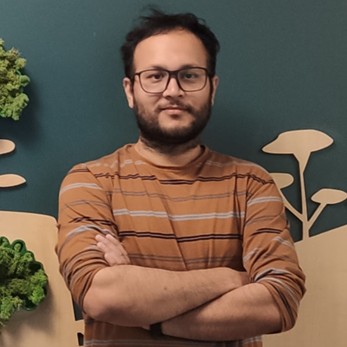
Since earning his Ph.D. from IIT Guwahati in 2018 for research in atomistic modeling, Sangkha Borah has established himself as a quantum physicist working at the vanguard of machine learning and quantum technology. Following high-impact postdoctoral tenures at the Okinawa Institute of Science and Technology (OIST) and the Max Planck Institute for the Science of Light, where he contributed to the Munich Quantum Valley initiative, he joined IIT Hyderabad as an Assistant Professor. As the lead of the Quantum Information, Computing, and Control Theory (QuICCT) research group, he develops algorithms for quantum error correction, quantum machine learning, measurement-based feedback control, and quantum neuromorphic computing. His work focuses on adapting modern AI concepts—such as reinforcement learning, physics-informed neural networks, and representation learning—to stabilize and optimize noisy, near-term quantum hardware. Beyond quantum information, he explores interdisciplinary applications in photonics and condensed matter physics, a pursuit complemented by his interests in reading and exploring emerging trends across physics and computer science.
For more information about the group and the research activities please visit his group website: https://sborah53.github.io/QuICCT/
Course Assessment
Assessment may consist of assignments &/or quizzes &/or viva &/or exams.